| biography |
| Biography | Timeline | Bibliography | Gallery | Further Reading |
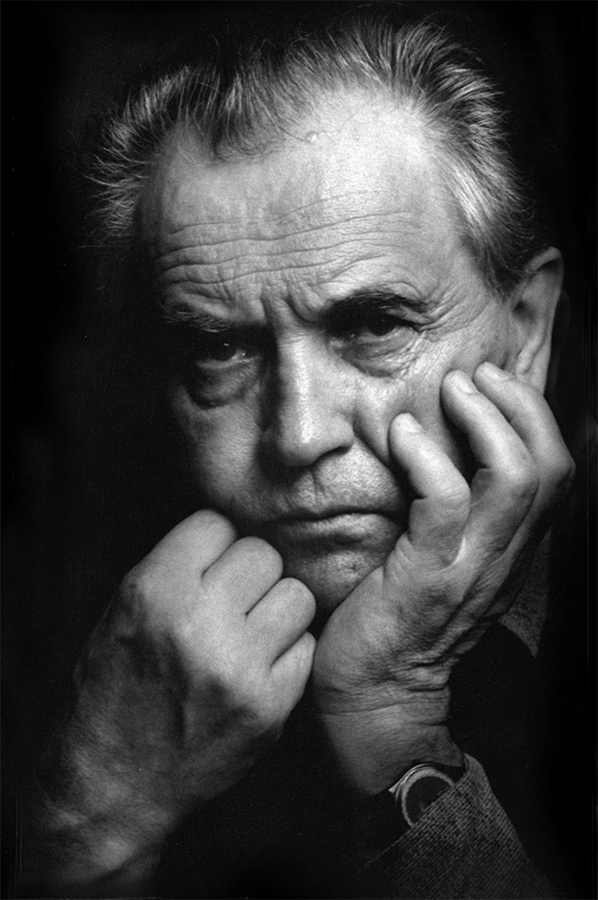 |
Alexander Alexandrovich Zinoviev
Александр Александрович Зиновьев |
|||
| Born | 29 October 1922
Pakhtino, Kostroma Governorate, Russian Socialist Federative Soviet Republic |
|||
| Died | 10 May 2006 (aged 83)
Moscow, Russian Federation |
|||
| Education | State University, Moscow (1951)
Doctor of Philosophy (1962) Professor |
|||
| Signature |  |
|||
| Biography | ||
Alexander Alexandrovich Zinoviev was born on October 29, 1922, in the village of Pakhtino, Chukhloma County, Kostroma Province (a now-disappeared village in the Chukhloma District of the Kostroma Region). He was the sixth child in the family of craftsman Alexander Yakovlevich and peasant Apollinaria Vasilievna (née Smirnova). Zinoviev’s father spent most of his time working in Moscow, having lived between the village and the capital since his youth, which, according to biographer Pavel Fokin, helped the family avoid repression during the dekulakization period. Before the revolution, Alexander Yakovlevich painted churches as an iconographer and later did finishing work and made stencils. Alexander Yakovlevich was interested in art, bringing his children drawing supplies, illustrated magazines, and books. Biographers highlight the mother’s role in shaping Alexander’s personality. Zinoviev remembered her with love and respect for her worldly wisdom and religious beliefs, which set the rules of conduct at home. From an early age, Alexander stood out for his abilities and was immediately promoted to the second grade. In 1933, after completing elementary school in his hometown, on the advice of a math teacher, his father took him to Moscow, where he received his secondary education. In 1939, he entered the Institute of Philosophy, Literature, and History (IFLI); he hid from arrest for anti-Stalinist remarks, wandered the country for a year, and in 1940 joined the Red Army. He participated in the Great Patriotic War, serving as a cavalryman, tank crewman, and assault aviation pilot. From 1946 to 1954, he studied at the Faculty of Philosophy of Moscow State University named after M. V. Lomonosov (MSU). His dissertation "The Ascent from the Abstract to the Concrete (based on Marx's 'Capital')", written in 1954 (published in 2002), initiated scholarly interest in developing the categorical framework of substantive ("genetic") logic. From 1955 to 1976, he worked at the Institute of Philosophy of the USSR Academy of Sciences. From 1963 to 1976, he taught logic at the Faculty of Philosophy of Moscow State University (headed the Department of Logic from 1965 to 1968). Numerous works from this period focused on the problems of logic, which he considered to be the analysis of language as a "sign system" of cognition. Zinoviev pioneered systematic research in the field of non-classical mathematical logic, particularly many-valued logic and the theory of logical consequence; he developed the concept of "complex logic," which, in addition to the linguistic, also included ontological and epistemological aspects. After the publication in 1976 in Switzerland of his book "Yawning Heights", a critical study of Soviet society presented in a literary form and gaining international recognition, A. A. Zinoviev was stripped of his citizenship, all academic titles, and military honors, and expelled from the country. From 1978 to 1999, he lived in Munich. His "sociological" novels and novellas of the late 1970s and early 1980s depict character types and interpersonal dynamics typical for him, revealed through their conversations and actions, often without individual names. In 1999, he returned to Moscow and became a professor at Moscow State University, the Moscow Humanitarian University, and several other institutions. In 2002, the philosopher's last book, "The Russian Tragedy (The Death of Utopia)", was published, in which Zinoviev wrote about the phenomenon of the "post-Soviet" and reflected on Russia's place in the global world. Alexander Alexandrovich Zinoviev died on May 10, 2006. According to his will, he was cremated, and his ashes were scattered from a helicopter over the village of Pakhtino in the Chukhloma District, where he was born and raised. In recognition of his contributions to Russian culture, a symbolic grave-cenotaph was erected at the Novodevichy Cemetery in Moscow. |
||
| Timeline | ||
October 29, 1922 – Born in Pakhtino village, Kostroma Province 1933 – Moved to Moscow 1939 – Entered Moscow Institute of Philosophy, Literature, and History (IFLI) Late 1939 – Expelled from Komsomol and the institute for political remarks and absenteeism 1940 – Arrested for plotting against Stalin; escaped from Lubyanka; went into hiding 1940–1941 – Served in the 98th Cavalry Regiment, 31st Cavalry Division, Far Eastern Army 1941–1945 – Fought in the Great Patriotic War as a tank crewman and assault pilot 1945 – Awarded the Order of the Red Star June 23, 1946 – Discharged from the Red Army as Guard Junior Lieutenant Late 1940s–1950s – Studied at the Philosophy and Mechanics & Mathematics faculties of Moscow State University; completed postgraduate studies 1953–1976 – Member of the Communist Party of the Soviet Union 1954 – Defended dissertation: "The Ascent from the Abstract to the Concrete" 1963–1969 – Head of the Department of Logic, Faculty of Philosophy, MSU 1965–1976 – Member of editorial board of Voprosy Filosofii journal August 6, 1978 – Stripped of all titles and expelled from USSR after publication of "Yawning Heights" 1978–1999 – Lived in Munich; published literary, philosophical, and journalistic works abroad March 9, 1990 – Televised debate with Boris Yeltsin on French channel Antenne-2 1990 – Reinstated in Soviet citizenship by Supreme Soviet of the USSR 1991 – Declared USSR collapse the greatest social catastrophe of the 20th century May 27, 1994 – Russian General Prosecutor's Office opened a case over interview "World Scoundrelity"; no legal consequences 1999 – Returned to Russia; candidacy for Nobel Prize withdrawn over stance on NATO's aggression in Yugoslavia 1999–2006 – Professor at MSU (Department of Ethics), Institute of Philosophy RAS, and other institutions February 29, 2000 – Became President of the Russian Intellectual Club May 10, 2006 – Died in Moscow |
||
| Bibliography | ||
Ascent from the Abstract to the Concrete (based on Marx's "Capital") [Восхождение от абстрактного к конкретному (на материале «Капитала» К. Маркса)] Dissertation Abstract., 1954 The Philosophical Problems of the Polyvalent Logic [Философские проблемы многозначной логики], 1960 Propositional Logic and Theory of Inference [Логика высказываний и теория вывода], 1962 The Principles of the Scientific Theory of Scientific Knowledge [Основы логической теории научных знаний], 1967 Complex Logic [Комплексная логика], 1970 The Logics of Science [Логика науки], 1971 Logical Physics [Логическая физика], 1972 Logical Language Rules: An Introduction to Logic (with H. Wessel) [Logische Sprachregeln] Berlin/Munich/Salzburg, 1975 The Yawning Heights [Зияющие высоты], 1976 The Radiant Future [Светлое будущее], 1978 On the Threshold of Paradise [В преддверии рая], 1979 Notes of the Nightwatchman [Записки ночного сторожа], 1979 Without Illusions: Collection of Articles [Без иллюзий. Сборник статей], 1979 Communism as a Reality [Коммунизм как реальность], 1980 The Yellow House [Жёлтый дом], 1980 (2 volumes) We and the West: Collection of Articles [Мы и Запад. Сборник статей], 1981 Homo Soveticus [Гомо Советикус], 1982 My Home – My Exile: A Poem Story [Мой дом — моя чужбина. Повесть в стихах], 1982 Gospels for Ivan: Poems [Евангелие для Ивана. Стихотворения], 1984 No Liberty, No Equality, No Fraternity: Collection of Articles [Ни свободы, ни равенства, ни братства. Сборник статей], 1983 The Wings of Our Youth: A Literary-Sociological Essay on Stalinism [Нашей юности полёт: литературно-социологический очерк сталинизма], 1983 Non-standard Logic and Its Applications (Oxford lectures), 1983 Go to Golgatha [Иди на Голгофу], 1985 Para Bellum [Пара беллум], 1986 Gorbachevism [Горбачевизм], 1988 Katastroika [Катастройка], 1989 Live! [Живи], 1989 Allegra Russis / The Joy of Rus': Poems [Веселье Руси. Стихотворения], Milan, 1990 The Embroilment [Смута], 1994 The Russian Experiment [Русский эксперимент], 1994 The West: The Phenomenon of Westernism [Запад. Феномен западнизма], 1995 Post-Communist Russia: Journalism 1991–1995 [Посткоммунистическая Россия: публицистика 1991—1995], 1996 The Global Humant Hill [Глобальный человейник], 1997 The Russian Fate, Confession of a Dissident: Memoirs [Русская судьба, исповедь отщепенца], 1999 The Endeavour [Затея], 2000 Essays on Complex Logic [Очерки комплексной логики], 2000 The Death of Russian Communism [Гибель русского коммунизма], 2001 Ascent from the Abstract to the Concrete (based on Marx's "Capital") [Восхождение от абстрактного к конкретному] Reissue., 2002 The Russian Tragedy: The Death of a Utopia [Русская трагедия], 2002 The Logical Sociologe [Логическая социология], 2003 The Ideology of the Party of the Future [Идеология партии будущего], 2003 Suprasociety Ahead [На пути к сверхобществу], 2004 The Logical Intellect [Логический интеллект], 2006 The Crossroads [Распутье], 2005 On the Horse, Tank, and Assault Aircraft: Notes of a Warrior-Philosopher [На коне, танке и штурмовике: записки воина-философа], 2018 |
||
| Gallery | ||
|
||
| Further Reading | ||
|
|
||